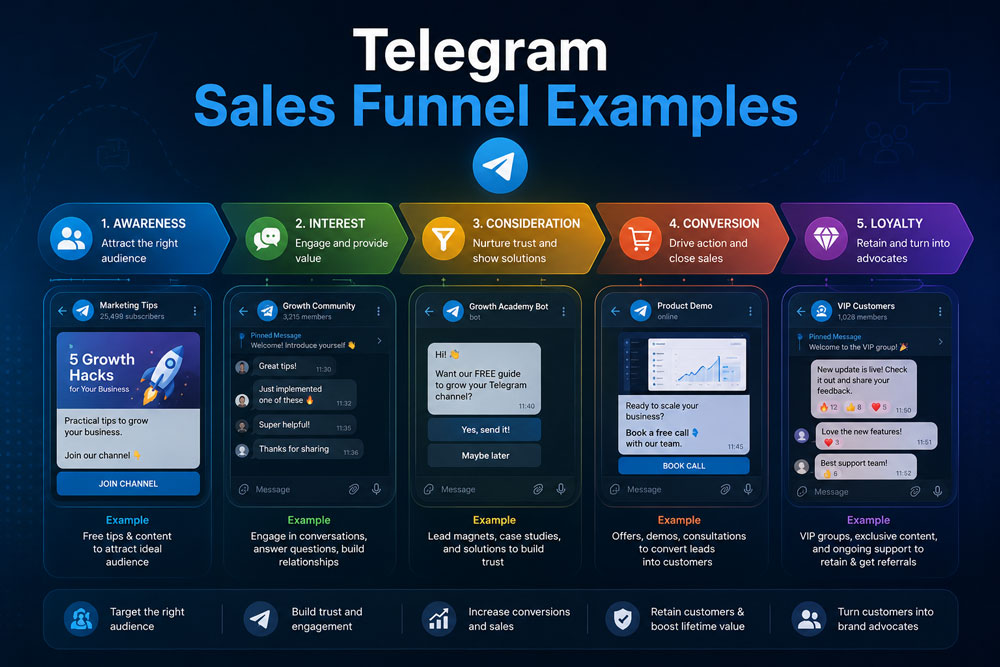
Most Telegram channel owners have the same problem: they post consistently, the subscribers are there, but revenue doesn’t follow.
The missing piece is almost never the content and almost never the offer. It’s the structure between them — the sequence that moves a passive subscriber through awareness, trust, and action in the right order.
That structure is a funnel. And on Telegram, funnels work differently than they do on other platforms — which is both the challenge and the advantage.
Telegram gives you direct access to your audience with no algorithm filtering what they see. Your post reaches subscribers within minutes of publishing. That’s a higher-trust, higher-attention environment than any social feed. But it only converts if the sequence is right.
This guide skips the theory. Below are five funnel structures that work on Telegram in 2026, each with a real example, the post sequence, and the conversion rates you can expect.
What Every Telegram Sales Funnel Has in Common
Before the examples, the three elements that every working Telegram funnel shares:
An entry point that filters for intent.
The best Telegram funnels don’t try to sell to everyone. They use the first touchpoint — a post, a pinned message, a free offer — to surface the subscribers who are actually close to buying. Everyone else stays in the channel and continues consuming content.
A trust layer before the offer.
On Telegram, the trust environment is higher than social media, but it still needs to be earned. Every funnel in this guide includes at least one step between “awareness” and “offer” that builds credibility — proof, demonstration, or social validation.
A specific, low-friction next step.
The best Telegram funnels don’t ask subscribers to make a buying decision in one jump. They ask for a small action first — a DM, a free trial, a click — that moves intent into behavior. The purchase follows.
With those principles in mind, here are five real funnel structures.
Example 1: The Free Trial Funnel
Best for: Service sellers with a testable product
Real example: Marcus runs a Telegram channel with 800 subscribers where he posts daily tips about growing Telegram channels. He sells SMM services — primarily member packages and reaction boosts — but wasn’t converting any of his audience to buyers.
The problem: His subscribers consumed content willingly but had no direct experience with his service. The trust gap between “this person knows what they’re talking about” and “I’ll pay them for a service” was too wide to close with a post alone.
The funnel structure:
Week 1, Post 1 (Value): Educational post about why member count affects
                         channel credibility → no offer, pure value

Week 1, Post 3 (Proof): Screenshot/data showing before-after results
                         from a client channel → social proof, still no offer

Week 2, Post 5 (Offer): "I'm offering 10 subscribers a free test of
                         [service] this week. DM me 'FREE' to claim."
                         → low-friction entry point

Follow-up DM: Deliver the free trial → ask for feedback →
              offer the paid package with context from their results
Conversion rate: 8–12% of free trial claimants convert to a first paid order within 14 days. Of those, 60–70% become repeat buyers.
Why it works: The free trial removes the primary objection — uncertainty about results — without requiring the subscriber to commit money. Once they’ve seen real delivery, the conversion to paid is a continuation, not a leap.
For service sellers using SMMPlus: this funnel maps directly onto the free service tests available on the platform. You can offer your channel subscribers a free Telegram members test or a free reactions test as your funnel’s entry point — the free trial is already built, you just need the post sequence around it.
Example 2: The Content-to-DM Funnel
Best for: High-ticket services, consulting, custom packages
Real example: Priya runs a 500-subscriber Telegram channel for social media marketers. She offers custom Telegram channel growth packages at $150–$500. Her previous approach — posting the offer link directly — converted at under 0.5%.
The problem: High-ticket services require more trust than a post can build alone. Subscribers who might genuinely need her service were dismissing the offer because they hadn’t had a conversation with her first.
The funnel structure:
Post 1 (Problem framing): "The 3 reasons Telegram channels stall at
                           500 members — and why the fix isn't more content"
                           → no offer, but directly addresses buyer pain

Post 2 (Proof): Case study of a channel that went from 500 to 3,000
                members in 6 weeks, with specific metrics
                → builds belief that the outcome is achievable

Post 3 (Entry point): "If your channel is stuck under 1,000 members
                       and you want to know exactly what's holding it back,
                       DM me 'AUDIT' — I'll take a look for free."
                       → surfaces intent without asking for money

DM sequence: Free quick audit → identify specific gap →
             present tailored offer → close with 48-hour window
Conversion rate: 15–25% of people who DM convert to paid within one week. Much lower volume than the free trial funnel, but significantly higher average order value.
Content types that generate the most DMs:
- Posts that name a specific symptom (“if your channel has X subscribers but under 30% view rate…”)
- Posts with a counterintuitive insight (“posting more often is one reason your views are dropping”)
- Posts that show a clear before/after with specific numbers
The key variable: the audit or conversation in the DM must deliver real value before making an offer. A DM that immediately pivots to selling — without giving the promised value first — breaks trust and loses the lead.
Example 3: The Pinned Post Funnel
Best for: Low-ticket digital products, one-time purchases under $50
Real example: Yusuf sells a $19 Telegram channel growth guide. He had 1,200 subscribers and was posting about his guide occasionally, with weak results. His pinned post was a generic welcome message.
The problem: His pinned post — the first thing every new subscriber sees — was wasting its position. New visitors had no immediate reason to consider buying, and the occasional offer posts were reaching subscribers at random points in their trust journey.
The funnel structure:
Pinned post rewrite:
  → Line 1: Who this channel is for (one sentence, very specific)
  → Line 2: What subscribers get from the channel (specific, not generic)
  → Line 3: Social proof signal (subscriber count, or a specific result)
  → Line 4: The offer (one specific product, one price, one link)
  → Line 5: The CTA ("Tap the link above to get [X]")

Content strategy: Every 8–10 regular posts → 1 "reminder post"
                  that references the pinned post and the offer
Pinned post template (adapts to any offer):
This channel is for Telegram channel owners who want to grow past 1,000 subscribers without spending money on ads.
Every week: one tactic, one case study, one metric that matters.
1,200+ channel owners follow this channel. The ones who’ve grown fastest used the system in the guide below.
[Your Offer Name] — $19 → [link]
Tap the link to get it.
Conversion rate: 2–5% of new subscribers purchase within the first 7 days of joining, without any additional follow-up. Low effort per conversion once the pinned post is optimized.
The most common mistake: making the pinned post about the channel (“Welcome to our community!”) instead of about the subscriber’s problem and the offer that solves it.
Example 4: The Social Proof Funnel
Best for: New channels, or channels stuck below 500 members
Real example: Chen has 180 subscribers and a legitimate service to offer, but every offer post gets ignored. He’s frustrated because his content quality is good and his service delivers results.
The problem: At 180 members, Chen’s channel fails a credibility check that prospective buyers run unconsciously. They look at the member count, the view rate on posts, and the reaction counts — and the numbers signal “small, unproven, risky.” Even a genuinely good offer gets passed over because the environment around it doesn’t support trust.
This is the funnel most channel owners skip entirely — and it’s the reason their offers don’t convert.
The funnel structure:
Phase 1 — Credibility foundation (before any offer):
  → Grow member count to 500+ minimum
  → Establish view rate above 25–30% of subscribers
  → Generate consistent reaction counts on posts (10+ per post minimum)

Phase 2 — Content sequence (2–3 weeks):
  → Post 1: Educational content, no offer
  → Post 2: Proof post (case study, result, screenshot)
  → Post 3: Community-building post (question, poll, invite replies)
  → Post 4: Second proof post

Phase 3 — Offer introduction:
  → Post 5: Soft offer ("For anyone who wants [result], here's how to get it")
  → Follow-up DM or pinned post update
Why the credibility phase matters: channels above 1,000 members with healthy engagement rates convert first-time offers at 3–5x the rate of channels below 300 members, with identical content quality. The social proof environment changes how subscribers evaluate offers.
For channel owners in this position, growing Telegram member count and maintaining healthy post view rates before launching offers is not optional — it’s the foundation that determines whether the offer phase works at all.
Conversion rate: Channels that complete Phase 1 and Phase 2 before offering see 3–8% first-offer conversion. Channels that skip Phase 1 and go straight to offers typically see under 0.5%.
Example 5: The Sequence Funnel
Best for: Recurring revenue, subscriptions, monthly packages
Real example: Amara runs a Telegram channel selling monthly Telegram growth packages ($30/month). She needed a funnel that converted subscribers to monthly buyers — not one-time purchasers.
The problem: One-time offer posts don’t build the recurring buyer relationship. Subscribers who bought once weren’t renewing, and new subscribers weren’t starting. She needed a sequence that warmed subscribers over time and made monthly renewal feel natural.
The 14-day sequence funnel:
Day 1:  Value post — specific insight about Telegram growth
Day 3:  Educational post — common mistake and the fix
Day 5:  Proof post — result from a current client (with permission)
Day 7:  Engagement post — question or poll that surfaces buying intent
        ("What's your channel's biggest challenge right now?")
Day 9:  Value post — addressing the most common answer from Day 7
Day 11: Proof post — second case study, different client profile
Day 13: Offer post — monthly package, specific price, specific outcome,
        limited spots ("Taking 5 new clients this month")
Day 14: Reminder post — "Last day for this month's intake"
For recurring revenue specifically:
- Announce monthly intake dates in advance (creates predictable anticipation)
- Share existing client results during the sequence (removes uncertainty about renewal)
- Use “limited spots” framing — it’s true for service businesses with real capacity limits
Conversion rate: 5–10% of channel subscribers who experience the full 14-day sequence convert in the first cycle. 65–75% of first-month buyers renew in month 2 when results are delivered.
How to Choose the Right Funnel
| Funnel | Channel Size | Offer Type | Time Investment | Expected Conversion |
|---|---|---|---|---|
| Free Trial | Any | Services with testable results | Medium | 8–12% of trial claimants |
| Content-to-DM | 300+ | High-ticket, custom | High | 15–25% of DMs |
| Pinned Post | Any | Low-ticket, one-time | Low (once set up) | 2–5% of new subscribers |
| Social Proof | Under 500 | Any (pre-offer phase) | Medium | Enables all other funnels |
| Sequence | 500+ | Monthly/recurring | High (ongoing) | 5–10% per cycle |
Simple decision rule:
- Under 500 members → start with Social Proof Funnel, then layer in Free Trial or Pinned Post
- 500–2,000 members, service-based offer → Free Trial or Content-to-DM
- 500–2,000 members, product-based offer → Pinned Post Funnel
- 2,000+ members, recurring offer → Sequence Funnel
Most channels eventually run multiple funnels simultaneously: a Pinned Post Funnel for new subscribers, a Sequence Funnel for the warm audience, and a Content-to-DM Funnel for high-ticket buyers.
For a deeper look at the psychology behind moving subscribers to paying customers, this guide on converting Telegram subscribers covers the framework that underlies all five funnel types.
Frequently Asked Questions
How long does it take to see conversions from a Telegram sales funnel?
The Pinned Post Funnel produces results within days of setup — new subscribers see the offer immediately. The Free Trial and Content-to-DM funnels typically produce first conversions within 1–2 weeks of launching the sequence. The Social Proof Funnel requires 4–8 weeks before the offer phase begins. The Sequence Funnel takes 14 days per cycle.
Do I need a bot to run a Telegram sales funnel?
No. All five funnels in this guide run without bots. Bots help automate delivery and follow-up at scale, but they’re an optimization, not a requirement. Start with a manual funnel and add automation once you understand what’s working.
What’s a realistic conversion rate for a Telegram channel?
For a channel with 500+ members running a tested funnel correctly, 3–10% of the engaged audience converting to paid buyers over 90 days is achievable. Without a funnel structure, most channels see under 0.5% conversion regardless of content quality.
How many subscribers do I need before running a sales funnel?
For the Pinned Post Funnel, any size works. For the Free Trial and Content-to-DM funnels, 300+ is the practical minimum. Below 300 members, the social proof environment is too weak for most offers — focus on the Social Proof Funnel first.
Can I run multiple funnels at the same time?
Yes, and most effective channels do. New subscribers enter through the Pinned Post Funnel automatically. Your warm audience experiences the Sequence Funnel through regular posting. High-intent subscribers who DM enter the Content-to-DM Funnel individually. These don’t conflict — they serve different segments of your audience simultaneously.
What’s the single biggest mistake channel owners make with Telegram funnels?
Skipping the Social Proof Funnel and going straight to offers when the channel is too small to support conversion. A 200-member channel offering a $30 service will almost never convert — not because the offer is bad, but because the credibility environment doesn’t support it yet. Building member count and engagement before making offers is the prerequisite that most people skip.
How do I know which funnel is working?
Track two numbers per funnel: the entry-point action rate (what percentage of subscribers take the first step — claim the trial, send the DM, click the pinned link) and the conversion rate from that action to purchase. If entry-point rate is low, the post that drives the entry point needs work. If entry-point rate is high but conversion rate is low, the trust-building or offer step is the problem.
Start With What You Have
You don’t need to build all five funnels before generating revenue from your Telegram channel. You need one — matched to your current channel size and offer type.
If your channel is under 500 members: fix the credibility foundation first. Growing your member count and maintaining healthy view rates are not vanity metrics — they’re the conversion environment that makes every other funnel work.
If you’re ready to test the Free Trial Funnel with real delivery: start with a free member test or a free reactions test — both require only your channel link and take under five minutes to set up.
Pick the funnel. Run the sequence. Adjust based on what you measure.